CRG Research Report - © 2006-2021, Camaro Research Group
LM1 – The 69 Budget Performer
Author -
Reviewed by the CRG
Last Edit: 17-Mar-2009
Previous Edits: 09-Mar-2008
Original Release: 28-Jul-2006
|
Index
Introduction
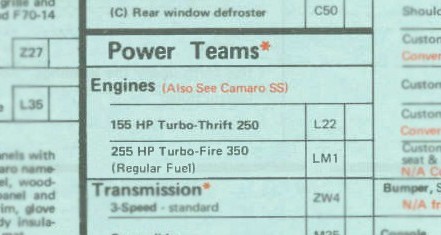 In 1969, a new engine option code appeared on Camaro order sheets. The LM1 was
a 350 cubic inch small-block engine rated at 255 hp. This was the first use of
the 350 in a non-SS Camaro. The only hint that this engine option was special
was hidden in the ordering information powertrain sheets; these sheets showed
the LM1 used the same higher performance manual transmissions as the SS Camaros.
The LM1 was a continuation of the 67-68 L30/M20 sleeper performance
concept and extended it to all transmission options, both 3- and 4-speed manuals
and 2- and 3-speed automatics.
In 1969, a new engine option code appeared on Camaro order sheets. The LM1 was
a 350 cubic inch small-block engine rated at 255 hp. This was the first use of
the 350 in a non-SS Camaro. The only hint that this engine option was special
was hidden in the ordering information powertrain sheets; these sheets showed
the LM1 used the same higher performance manual transmissions as the SS Camaros.
The LM1 was a continuation of the 67-68 L30/M20 sleeper performance
concept and extended it to all transmission options, both 3- and 4-speed manuals
and 2- and 3-speed automatics.
The Engine
The LM1 replaced the 1967-68 L30 (327/275hp) engine as the optional engine
between the base LF7 327/210 hp engine and the L48 350/300hp engine in the SS350
package. The extra 23 cubic inches of displacement over the L30 were gained by
increasing the engine stroke from 3.25 to 3.48 inches. The LM1 was available in
coupes or convertibles and cost only $52.70 (vs $92.70 for the L30). The LM1
had a Quadrajet four barrel carburetor and was similar in design and components
to the 1967-68 L30 and the 1969 L48 engines. The most notable difference was the
L30 and the 1969 L48 both used cylinder heads with smaller combustion chambers than
the LM1 (63 cc vs 76 cc) and thus had higher compression ratios and higher power
outputs. The horsepower difference on paper was 20 hp in favor of the L30, but
the torque rating of the LM1 was 10 ft-lbs more than the L30 (365 ft-lb for the
LM1 versus 355 ft-lbs for the L30).
 The LM1 engine was only available the first four months of the year, until the
end of December 1968. In January of 1969, the L65 350 engine
replaced it. It is unclear why the LM1 was discontinued in the Camaro. It has been
proposed it was emissions related, but the engine was still available in other Chevrolet car
lines. (The Camaro base 327 / 210 hp engine suffered a similar fate at the same time,
being replaced by the 307 / 200 hp engine. These engine changes cause confusion
in the factory and aftermarket literature. Most sources only list two of these
four engines.)
The LM1 engine was only available the first four months of the year, until the
end of December 1968. In January of 1969, the L65 350 engine
replaced it. It is unclear why the LM1 was discontinued in the Camaro. It has been
proposed it was emissions related, but the engine was still available in other Chevrolet car
lines. (The Camaro base 327 / 210 hp engine suffered a similar fate at the same time,
being replaced by the 307 / 200 hp engine. These engine changes cause confusion
in the factory and aftermarket literature. Most sources only list two of these
four engines.)
The change to the 350 engine size from the 327 was part of Chevrolet's broader engine
plan for the coming decade. The 307 would be replacing the 327 as the base V8
engine and the 350 engine would cover the mid-to-upper small-block power range.
In 1969, Chevrolet built 10,406 Camaros with the LM1 option, a little over 12%
of the production for the first four months of the model year, but only 4.2 % of
overall 69 production. For comparison, the base engine was 53% of production
for the 1969 model year and the L65 engine (that replaced the LM1) was 21% of
of production. The L30 option was ordered on just over 11% of 67
Camaros and 9% of 68 Camaros. So the sales rate of the LM1 was very similar to
the L30 that it replaced, but the L65 had almost double the sales rate of the
LM1.[1]
The LM1 Drivetrain
There was no special badging for the LM1 engined car – the only notable
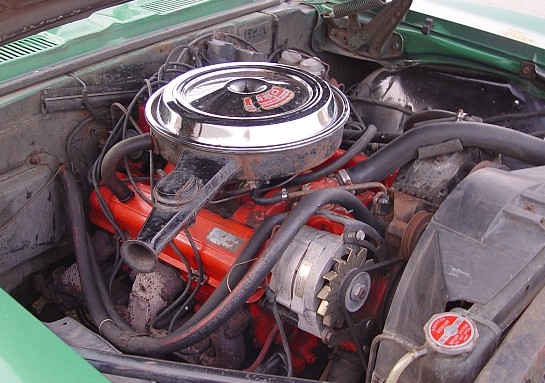
change was the engine had a chrome lid on the closed element air cleaner. The LM1 was
just the optional V8 engine for the first part of the 1969 production year. But
for unknown reasons, Chevrolet considered it to have enough power that almost
all LM1 cars -- both automatic and manual -- received upgraded powertrains.
Instead of the standard 10-bolt (8.125 inch diameter ring gear) axle, most LM1's used the
stronger 12-bolt (8.875-inch diameter ring gear) axles, normally reserved for SS and Z28
cars. This included most LM1 cars with powerglide transmissions, a notable
combination since most 69 SS350 cars with powerglides received 10-bolts. [2]
All LM1's had multi-leaf rear springs and
received the same default axle ratios as the SS350.
The base transmission for the LM1 was the heavy-duty MC1 3-speed manual
transmission, built by Muncie. This was the same base transmission offered with
all SS cars. All MC1 transmissions were floor shift.
LM1 cars ordered with the M20 4-speed received the superior Muncie 4-speed
transmission with an aluminum case instead of the lower capacity and heavier
Saginaw 4-speed transmission. (Note that M20 was not the name of the
transmission but rather was the functional designation for any standard
ratio 4-speed manual transmission.) The Muncie transmission combined
with the Hurst shifter that was used in all 69 4-speed cars made for a great
performing transmission.
These were marked changes from the L30 (327/275hp) engine that the LM1 replaced.
The Camaro L30 powertrains only received the 12-bolt upgrade when ordered with
the M20 4-speed transmission and then still used the lesser Saginaw
transmission. Why these upgrades in powertrain configurations were done for
1969 is unclear, but it may have been due to the increased torque of the LM1
engine.
The LM1 Replacement
The LM1 was replaced in January of 1969 by the L65 engine option, a 350 with a
2-barrel carb, rated at 250hp and priced at $21.10. Other than the carb, intake,
and distributor changes, it was the same engine as the LM1. It would appear
that this was a minor change with only a rated 5 hp reduction. But the
effect on the L65 powertrain was dramatic.
The standard axle for the L65 was the 10-bolt (though a few 12-bolts were used,
mostly in the first few months of L65 production). The base transmission
reverted back to the manual column shift (!) Saginaw 3-speed and the M20
transmission was now a Saginaw 4-speed again. The default axle ratios also
changed on the L65, to the detriment of performance. The default ratio of a
LM1/manual transmission powertrain was 3.31, whereas the L65/manual transmission
default axle ratio was 3.08. The default ratios for automatic transmission went
from 3.07 with the LM1 to 2.56 with the L65. The one feature that did not
change was the L65 still received multi-leaf rear springs.
Again, the technical reasons for the downgraded drivetrain components are
unclear, since the torque and horsepower output of the L65 should be very close
to the LM1. There are two other possible reasons:
• Marketing - did people really want to pay the extra money
for the drivetrain upgrades that came with the LM1?
• Profit margin - the cost of the drivetrain (namely the axle and the 4
speed transmission) could be reduced.
The L65 option price was reduced
significantly compared to the LM1 ($21.10 vs $52.70) with almost the same
horsepower rating. The jump in L65 sales rate (almost double the LM1 rate)
proved that people were more sensitive to price than features under the car
(features that most buyers didn't even know were there).
LM1 vs L48 SS
So, how did the LM1 compare to the 1969 L48 SS350?
The L48 was a 300 hp
version of the 350ci engine that was part of the SS package and was the base
high performance package. The LM1 and the L48 both were 350ci engines with
four-barrel carburetors utilizing the same intake manifold, carburetors,
transmissions, and 12-bolt rear axles.
- The main difference between the engines was the heads. The LM1 used the
3932441 heads that had a 76 cc chamber yielding a compression ratio of 9.0:1,
while the L48 used the 3947041 heads that had the 63 cc chamber. The smaller
chamber of the L48 caused an increase in the compression ratio to 10.25:1 and
thus increased the power output.
- The LM1 and L48 short blocks were the same; both used the same pistons,
rods, cast cranks, and camshafts. LM1's have been found with both 2-bolt
and 4-bolt blocks, though it appears that most were 2-bolt blocks. Most
L48's appear to have used 4-bolt blocks, but a few L48 engines been observed
with 2-bolt blocks. (There is no real functional difference between a 2-bolt
and a 4-bolt block at these power output levels.)
- There were minor differences in the distributor calibration, so the two
engines used different distributors.
- The LM1 exhaust system was 2" O.D., where as the L48 exhaust was 2.25" O.D.
- The LM1 with manual transmission used the smaller 10.4-inch clutch, whereas
the SS used the 11-inch clutch. (The smaller clutch was also used on Z28's, so
it wasn't really a weakness.)
- The LM1 and the L48 powertrains received the same default axle ratios: 3.31
for manual transmissions and 3.07 for automatic transmissions.
- The SS package included disc brakes. Drum brakes were standard on LM1 cars,
with power drums (RPO J50) and power discs (RPO J52) being available
options.
- The SS package included F41 special suspension, N10 dual exhaust, N44 fast
ratio steering (if power steering was ordered), and F70x14 tires on 14x7 wheels.
All of these features were optional on the LM1 except the wheels. The LM1 came
with 14x6 wheels.
- Appearance. The SS package included the D90 Sport Striping, SS badging, and
the SS hood and hood insulation. The D90 stripe was an option on the LM1.
- $$$$
The money difference could be pretty big, The cost was $52.70 for the LM1 engine option.
For an LM1 with disc brakes, dual exhaust, and F41 suspension,
it was $158.05 versus $295.95 for an SS350 (note
that it was another $62.60 to upgrade the tires to the L48 tires). To that price,
add the cost of any optional transmission ($175-$200) to either car. By adding the RPO D90 stripe
on the LM1 car for $25.30, it even looked like an SS except for the hood and SS badging.
The SS350 was a more complete package, but no doubt about it, the LM1 gave you a
lot of bang for the buck.
There was one notable ordering difference between the SS package and the LM1.
The base transmission, the MC1 HD 3-speed transmission, was included in the the SS package.
On the LM1, this transmission was a mandatory option for an extra $79. If any other
transmission was ordered (which most people did), the transmission cost was the same for either engine.
The fact the the SS price included the MC1 transmission did affect the orders.
To order a 4-speed on the LM1, it was only a $116 cost increment over the 3-speed;
on the SS350, the cost increment was the
full $195 price for the 4-speed. So most LM1 buyers spent the extra money and got a 4-speed
over the 3-speed. LM1's with a 3-speed are not very common, whereas SS350's with 3-speeds
are more common (though most have been converted to 4-speeds over time).
ID'ing the LM1
Please see the1969 Model ID
table to help determine if the original engine could be one of the other
engines available in 69.
 There was no special badging for the LM1 option, so the best way to identify an
LM1 is via factory or dealer documentation (e.g. window sticker, invoice,
protect-o-plate, etc) showing the options or via the original engine.
There was no special badging for the LM1 option, so the best way to identify an
LM1 is via factory or dealer documentation (e.g. window sticker, invoice,
protect-o-plate, etc) showing the options or via the original engine.
The LM1 engines for Camaro applications were stamped with the engine codes of HQ
for manual transmissions, HR for M35 Powerglide transmissions, and HS for M38
Turbo 350 transmissions and should be appropriately dated for the car. The
partial VIN should also be stamped on most engine pads (some of the later
December cars may have the VIN stamped by the oil filter).
If the original engine and original documentation are gone, it becomes tougher
to determine what the original engine was. Telling the difference between an
LM1 and an L48 SS in this case is difficult and sometimes not possible.
LM1's were only built for four months in 1969 model year - from start of
production until the end of December 1968. They were built at both the Norwood
and Los Angeles plants. Most will not have X-codes on the cowl tag since that
coding was introduced in mid-December on Norwood cars, but for those late
December Norwood cars with an X code, it would be an X11 or X44. An SS350 car
would be X11 or X55.
Several features were required on the SS. If they are missing, the car cannot
be an SS, but the presence of them does not prove that it is an SS since
they were optional on a LM1.
All LM1 and SS350 cars should have:
- 2 fuel lines due to the vapor return line for the Quadrajet carb
- 12 bolt rear axles (though 10 bolt axles had limited usage in some automatic
cars) [2]
- rear
brake line valve (note that usage of this valve was not always
consistent)
- multileaf rear springs
- Muncie 4-speed transmission if a 4-speed
- Muncie 3-speed transmission if a manual 3-speed.
SS cars had:
- disc brakes
- dual exhaust
- SS hoods (cowl hoods were not available until January of 1969)
- wider wheels
Two of these four features were optional on the LM1 – disc brakes and
dual exhaust. If the car has 2 fuel lines, 12-bolt, and a Muncie (if 4-speed),
but does not have disc brakes and/or the dual exhaust doubler plate (coupes only,
mounted on the driver's side rear frame rail), then it is a LM1 car.
If it does have discs and the dual exhaust doubler plate (coupes only), the results are
inconclusive, it could be either a LM1 or a L48. The only thing left to check
is the hood and hood springs,
but these could have been changed over the years.
Summation
There is no way to know how many people ordered the LM1 to get a sleeper of a
performace car and how many people never realized that their LM1 car had
drivetrain upgrades. But there definitely were observant people that realized
what was going on. Several original owners state that they ordered the LM1 for
the drivetrain and some original L65 owners tell how they were disappointed when
they got their car, expecting the LM1 drivetrain upgrades.
No, the LM1 was not a solid lifter terror on the street. But it was a
performance model - a continuation and expansion of the 1967-68 L30/M20
performance legacy. The automatic and 3-speed manual cars were now included -
the 12-bolt axle could handle any abuse the small block could deliver. The
manual 4-speed cars received the notable improvement
of the Muncie four speed with the Hurst shifter.
The LM1 was also a deal, especially considering the drivetrain upgrades that
were included with the engine. The possible savings over the SS350 was a good
chunk of change and you could order the options you wanted and pocket the
difference. The SS350 was a more complete package, but with the LM1, you could
end up with a sleeper of a car that was more than respectable on the street but
didn't draw too much attention. Which, for some people, was the whole point.
[1]
The L48 (SS350) was 10.5% of 1969 production.
[2] Note:
there have been a few LM1's observed with 10-bolt multlileaf axles. These
have all been automatic (mostly powerglide) cars; all manual LM1's have been observed with
12-bolts. The use of the 10-bolt appears to be time-based. Most of the 10-bolt cars
are LM1 powerglide cars that were built in the last 5 weeks of LM1 production.
A related fact is that 10-bolt axles were used in most SS350 cars with powerglides.
There isn't a lot of data on this combination but it also appears time-based.
SS350 cars with powerglides appear to use 12-bolts for the first months of production
and then 10-bolts were used the rest of the 69 model year.

