A CRG Research Report
Delco-Remy Transistor Ignition Systems as Used on the Early
Camaro
A Comprehensive Primer to the Forgotten Delcotronic
Transistor-Controlled Magnetic-Pulse-Type Ignition System
© 2003-2007, Thomas M. Bogan and
Camaro Research Group
Contributing Author -
Reviewed by the CRG
Last Edit: 28-Jun-2003
Previous Edits: 28-Jun-2003
Original Release: 28-Jun-2003
|
Acknowledgments
Note: Prior to this point CRG Research Reports
had only been written by CRG members. However, CRG never
intended that the Research Report appellation be
restricted to CRG member authorship. While Dr. Bogan is not
a CRG member, his offer to have CRG publish this significant
research contribution merits highlighting the work as a CRG
Research Report. CRG thanks Dr. Bogan for his work as a
contributing author to the CRG!
The author is indebted to the following people for their
help and knowledge in refining this article into its current
state. "No one is as smart as all of us." My
special gratitude to:
Dave Fiedler of T.I. Specialty, www.tispecialty.com
Wayne D. Guinn, author of "Untold Secrets"
Larry Christensen of Camaros Plus
Bill Glowacki, Rich Fields, Jon Mello, and Kurt Sonen of the Camaro Research Group
My wife Lori-for her understanding of my obsession
Background History of the TI System
The "Delcotronic Transistor Controlled Magnetic Pulse
Type Ignition System" is seldom, if ever, seen or
discussed, but it was a key part of Chevrolet's racing
success during the late 1960's and early 1970's. This
special transistor controlled ignition system was developed
for high performance and racing use to replace the
traditional point-fired ignition system found on regular
production vehicles. This first electronic ignition, known
by such names as Magnetic Impulse, Mag-Pulse, Transistor
Ignition, or simply TI, became the standard in heavy-duty
high performance Chevrolet ignition systems. With the
development of newer technology such as capacitive
discharge, multiple spark, and multi-coil systems, these
early milestones of Chevrolet racing history have almost
been forgotten. Up until the development of the MSD ignition
systems in the mid-1970's, you'd be hard pressed to find a
better ignition system for your race or high performance
Chevrolet. These systems earned the praises of racers
because they solved many of the problems inherent to the
point ignition systems.
Point triggered ignition systems can bounce (limiting rev capability)
unless they have very high tension point sets. These high tension
points are fine for short distance racing. However, when high tension
points are used in an endurance racing event such as Trans Am or
NASCAR, the rubbing block wears at a fast rate. This results in
increased dwell angle, retarded spark timing and eventual complete
ignition failure. The problem is critical in endurance events where
the engine is expected to run at high RPM for an extended period of
time. The TI system solved these problems and was reliable up to
10,000 RPM all day long. Instead of using a point set to make and
break electrical contact to the coil, the TI uses a magnetic pickup
and transistors to interrupt the coil current and fire the spark plug.
Racers quickly made these the "standard" in racing ignition
systems for Chevrolet and Pontiac engines. In their day, TI systems
had widespread use in many racing series such as Trans Am, Can Am,
road racing, NASCAR, drag racing, and others. Many races and
championships were won with TI systems.
Delco-Remy first developed their new transistor controlled
ignition system for the full-size Pontiac 389 and 421
engines on 1963 models. Throughout the 1960's, various cars
could be ordered with a TI system including Corvettes,
full-size Chevrolets (including the 409), Chevelles, Chevy
II's, and eventually as an over-the-counter (OTC) setup to
install on any Chevrolet small or big block engine. The 1969
aluminum block ZL1 was the only Camaro that came with a
factory installed TI system.
When the Camaro debuted in the fall of 1966, several racing
series were underway and growing in popularity. To help
bolster its performance image and sales, Chevrolet wanted to
prove their new car in competition, especially in the SCCA's
Trans Am series. To do this they created a new Camaro model
that would be known as RPO Z28. By destroking the 327ci
engine with a heavy-duty version of the 3-inch stroke
crankshaft from the 283ci engine, the now-famous 302ci Z28
engine was created, which just met the SCCA five-litre
engine displacement limit. This special high-revving engine
had several high performance components that helped it to
develop considerably more output than the advertised 290 HP.
The first run of RPO Z28 Camaros was built in late December
1966/early January 1967 for the fast-approaching Trans Am
racing season, which would start with Daytona in early
February. The majority of these were intended primarily for
racers and delivered to select dealers to be setup as race
cars.
Chevrolet wanted to be competitive quickly and put their
Engineering, Research & Development, and Product
Performance Liaison groups to work developing racing
components for the Camaro. At the time, official Chevrolet
Corporate policy was that they were not involved in racing
or sponsorship of any racing activity. However, behind
closed doors, these departments were very busy developing
parts aimed at making the Camaro a successful racer. The
competition parts were available initially only to those
that Chevrolet selected. Eventually these special parts
became known and available to the racing public to satisfy
the SCCA and other sanctioning bodies.
Chevrolet did publish this information. First, you had to
know that this information even existed. If you could then
write a convincing letter, Chevrolet Engineering would send
a special set of four photocopied pamphlets out to you in a
plain envelope. The "Camaro Z-28 Heavy Duty Parts"
and "302-327-350 Heavy Duty Parts" lists
catalogued competition parts that were not listed in the
regular parts book. The "Camaro Chassis
Preparation" sheets were special instructions available
for setting up a Camaro chassis for Trans Am racing use and
"Clearance and Specifications for Heavy Duty Service
302 CU. IN. Chevrolet Engine" sheets were instructions
on how to setup the engine. These sheets evolved into the
Chevrolet Special Equipment manual, (also known as the Green
Sheets) which in the early 1970's then became the Chevrolet
Power Manual. Both Paul Van Valkenburgh's book Chevrolet
= Racing? and Mark Donohue's book The Unfair
Advantage are highly recommended reads and discuss
different aspects of Chevrolet's clandestine involvement in
racing.
The world would soon find out that the Z28 was a serious
contender at the racetrack. And the Camaro would soon be a
very popular vehicle on the dealership sales lots as well.
In their first year of competition in 1967, the Z28 Camaros
performed well in drag racing, but started very slowly in
their intended target - road racing - because it took longer
than anticipated to resolve rear suspension and brake
problems. But the suspension and brakes were sorted out
with great success by the end of the 1967 Trans Am racing
season, and though the Z28 did not win the overall
championship in 1967, it did finish its first season on a
high note with a string of victories. The Z28 went on to
dominate Trans Am racing in 1968 and 1969 as the Roger
Penske and Mark Donohue Sunoco Camaros had incredible
success, winning the championship both years.
Many of the components that were developed for the Camaro
racing programs were actually borrowed from other existing
lines such as: Corvette disc brakes, Cross-Ram intake
manifold from the Mark IV engine program, and the cowl
plenum induction from the 409. The Transistorized Ignition
is yet another example of this. A new TI distributor, PN
1111267, was made with an advance curve specifically
tailored for the 302 engine. A special amplifier mounting
plate, PN 3916730, was made. And the bulk of the remaining
components were borrowed from existing applications: The
main harness PN 2988218 from the full-size Chevrolet, along
with PN 6287841 starter extension harness, the existing
ignition amplifier PN 1115005, the existing TI coil PN
1115207, and the PN 2987102 ignition switch power feed
extension from the 1966 Nova. These parts along with some
miscellaneous items (wiring connector, ties, grommet,
instruction sheets) comprised the first Transistor Ignition
systems for the new Camaro. It was only available as an
over-the-counter (OTC) service part.
Coincidentally, with the introduction of the Camaro in 1966,
the Delco-Remy TI system was undergoing several revisions.
Because of this, several design changes took place that
added confusion about these systems. The very limited
production of these parts furthered the confusion. It is
hoped that this article can clarify how the TI systems were
used on the early Camaro. A convenient summary table is
included to help the reader in understanding how they were
setup. It is hoped this will aid anyone considering one of
these systems for use on their Camaro.
System Components
A Transistor Ignition system consists of the following components:
- Special magnetic pulse distributor
- Ignition pulse amplifier
- Mounting plate for amplifier
- Special TI Coil
- Wiring harness assemblies
- Miscellaneous parts (retainers, grommet, wiring connector,
instruction sheets)
All parts were available separately. For convenience, a kit
was available that included all necessary items, less the
distributor. This kit was called a Transistorized Ignition
Unit (TIU). These TIU's helped prevent a lot of headaches
when setting a system up. Most original systems were setup
with a TIU. Today most are setup by pieces. The following
sections will look at each of these TI components separately
and discuss the changes that were made over the years.
Magnetic Pulse Distributors
The initial offering for the TI distributor on Camaros was
PN 1111267 for the 1967 Z28. Essentially it was a regular
iron-housing, mechanical-tach-drive, TI distributor with an
appropriate advance curve to suit the 302 CI engine. The
specifications were 14 degrees maximum mechanical advance at
2300 RPM (distributor degrees and RPM). It had a vacuum
advance feature that most racers did not utilize. The 267
distributor was one of the distributors recommended in the
Heavy Duty Parts listings and Chassis Preparation Sheets and
was available from November of 1966 up to the mid-80's.
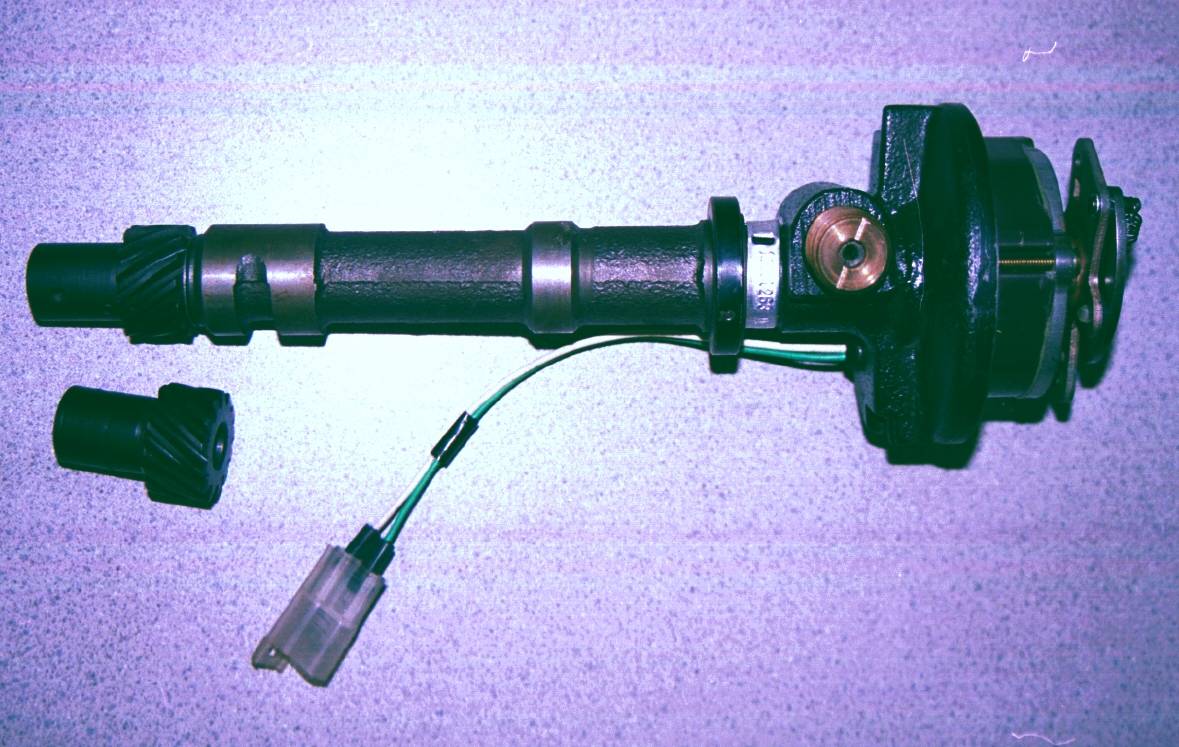
An alternative distributor was also listed. This is the
highly prized ball bearing distributor PN 1111263. This
heavy-duty version was initially released for the
reverse-drive camshaft 427 big block racing engine. It has a
special ball bearing on the upper part of the mainshaft
instead of the usual bronze bushing. This distributor has an
iron housing with a mechanical tach drive and has a special
reverse-drive distributor gear that permitted clockwise
rotation of the distributor in this special 427 engine. It
specified 13 degrees maximum mechanical advance at 1900 RPM.
This distributor did not have a vacuum advance feature; the
plate inside the distributor was fixed in position. (This
distributor was still listed in the 1991 Chevrolet parts
books, for $1,699.05!)
The TI ball bearing distributor PN 1111263.
(Note the incomplete oil groove and compare drive gear to
the standard drive gear on left.)
(click on the image to expand it)
 |
The 263 distributor required two changes for use in the
small block 302 engine. First, the provided drive gear was
replaced with the standard drive gear. And second, the lower
oiling channel on the lowest boss was extended full
circumference. (As supplied by Chevrolet, the lower oiling
channel traversed only 3/4 of the circumference; if not
fully grooved - like the standard small-block distributor -
the oil passage that feeds the right-side camshaft lifter
bank could be blocked, resulting in immediate engine
failure!) In addition, it was often desirable to revise the
provided advance curve to better match a given application.
(Most racers changed the advance curve anyway.)
The 263 ball-bearing distributor had an advantage when the
Cross-Ram dual 4-barrel setup became available for the 1968
Trans Am racing season. Because the 263 didn't have a vacuum
advance unit it was easier to clear the number eight runner
on the Cross-Ram manifold. The distributor tach drive could
be moved around to suit the application. The previously
mentioned 267 distributor can also be used, but it is a much
more difficult fit in the Cross-Ram manifold application.
A third TI distributor for OTC TI applications was PN
1111095. This was a ball-bearing distributor similar to the
263, but without a tach drive.
The fourth TI distributor is the one that came from the
factory on the sixty-nine 1969 ZL1 cars. These were the
only Delco-Remy Transistorized Ignition systems
that were factory installed on the early Camaros. This
distributor is PN 1111927. This distributor has an iron
housing with a mechanical tach drive and it was provided
with 14.5 degrees maximum mechanical advance at 2500 RPM.
The distributor had a dummy vacuum advance without a hose
attachment that served to fix the advance plate into
position in the distributor and a plastic cover over the
tach drive hole.
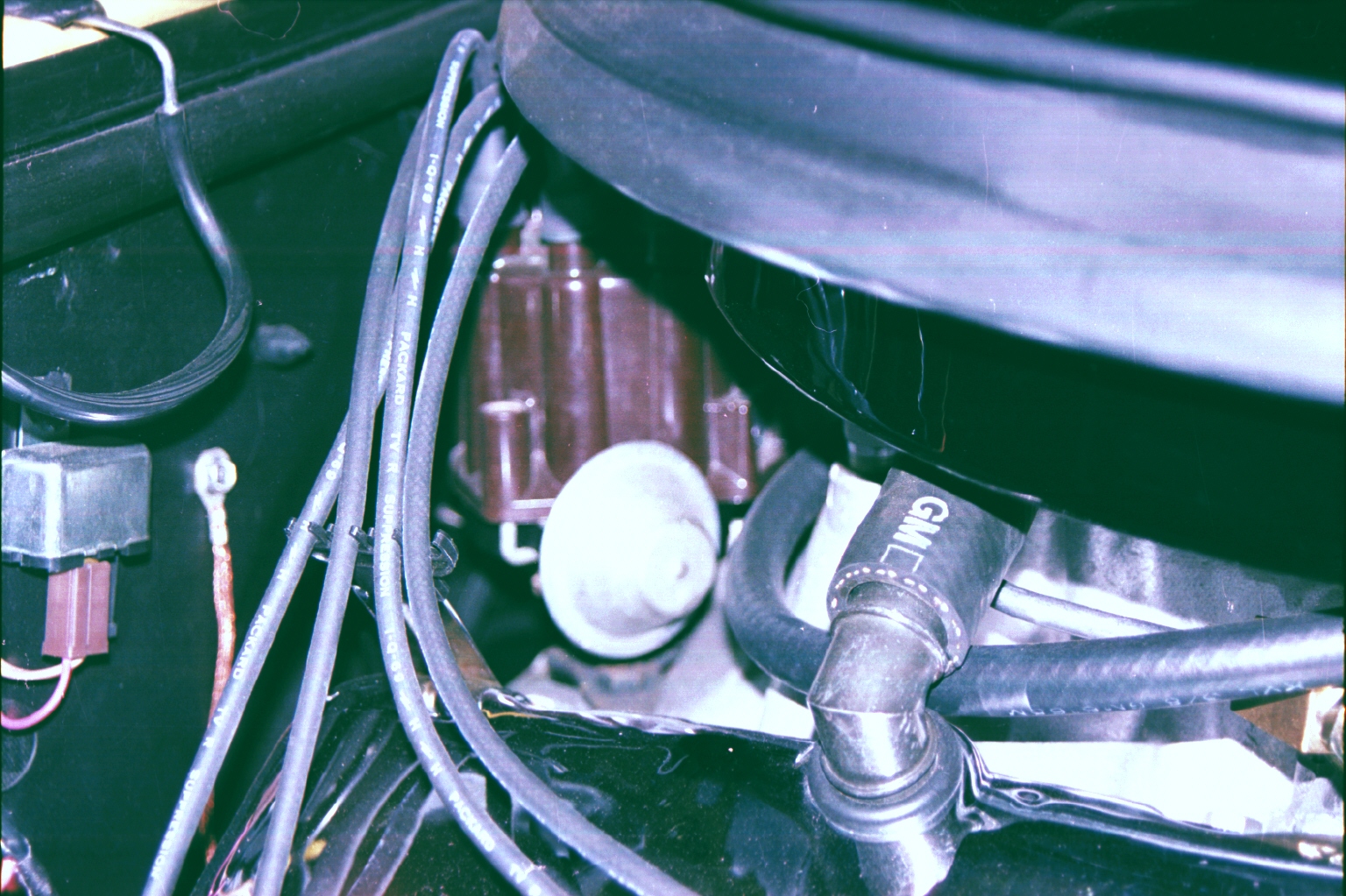
The TI ZL1 distributor PN 1111927.
(Note the vacuum advance unit and brown cap.)
(click on the image to expand it)
 |
As yet another option, parts were also available to convert
a standard aluminum distributor to a TI magnetic pick-up
distributor.
It was possible to use any of these distributors (or a TI
distributor from other Chevrolet models, e.g. Corvette,
Chevelle, etc) on other Camaro applications; they were not
necessarily limited to use on the 302 Z28 or 427 ZL1.
Ignition Pulse Amplifiers
The Delco-Remy ignition pulse amplifier for the transitor
ignition were built with germanium-type transistors, which
were the best available at the time the TI systems were
developed. However, germanium transistors have a notable
problem with heat sensitivity. Some reports indicate 140
degrees Fahrenheit is enough to damage them. Being at least
somewhat aware of the issue, Chevrolet specified that the
amplifier be mounted (more below) on the hood latch support
brace in order to receive maximum benefit of cooling air.
This helped avoid heat related failure. The author still
uses his original circuit board and has had no troubles -
but he carries a spare wherever he goes! (This heat problem
has been addressed in the modern silicon transitor
replacement circuit board assemblies that are available from
M&H Electrical Fabricators, Inc. and several restoration
parts suppliers (see the resources listing at the bottom of
article). The silicon-based replacements are inherently much
less heat sensitive than the originals.)
The amplifier that Chevrolet originally specified for use in
OTC systems was PN 1115005; this part has the plug-in socket
style connector. Chevrolet identified a moisture intrusion
problem with the 1115005 amplifier in other vehicles in
their Service News publication dated November 1966, just as
the Camaro TI systems were coming out. The problem was
aggravated by the mounting position in the grille. To
correct the problem Chevrolet recommended drying the circuit
board, then spraying it with lacquer or wire protective
spray. They additionally recommended coating the cover
gasket (old style gasket) with silicone grease, and putting
additional grease between the cover and the base after
reassembly. This attempt at a corrective action did not
fully solve the moisture issue.
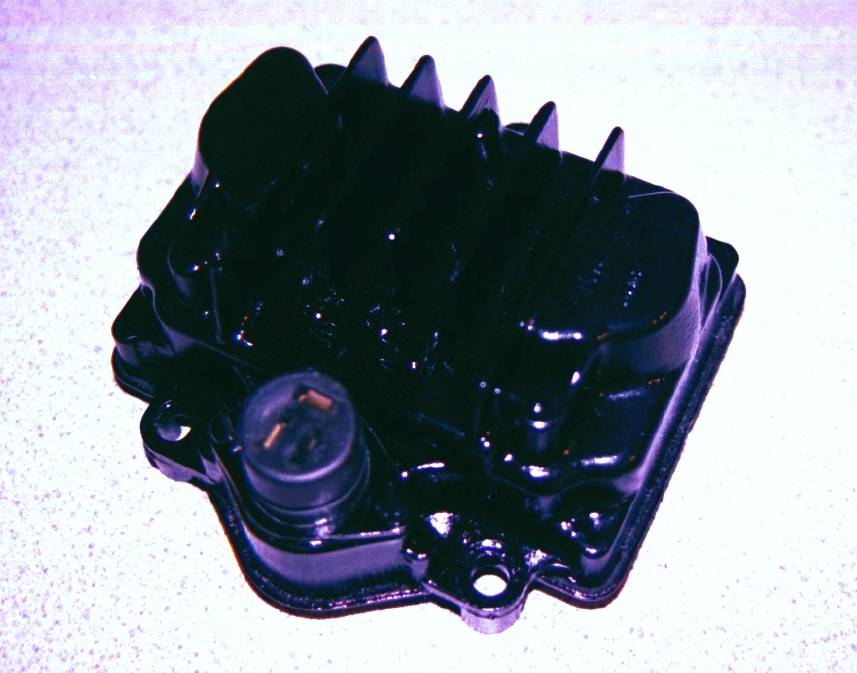
OTC TI Amplifier PN 1115005.
(Note plug-in connector.)
(click on the image to expand it)
 |
Delco-Remy separately sent out a service bulletin in April
1967 with corrective measures, and another revised bulletin
in May 1968. The problem according to them was 1) moisture
leakage past the back cover seal into the main housing and
2) moisture intrusion into the electrical connection at the
plug.
To help correct the leakage problem, in January 1967
Delco-Remy released a re-designed cover plate and gasket.
The original cover had a formed-in-place gasket; this new
design cover had a separate rubber gasket. The first design
cover is easily identified by its curved edges that somewhat
"cupped" around the amplifier housing, while the re-designed
plate was flat. The new cover PN 1960625 and gasket PN
1970226 were available as service parts from your Chevrolet
or Delco-Remy part supplier. And to correct the electrical
connector leak, Delco-Remy specified to pack the connector
harness plug half-full with a special Dow Corning silicone
grease. (Be aware that dielectric grease is a non-conductor
of electricity and it can interfere with a good electrical
connection.)
These continuing problems led Delco-Remy to redesign the
amplifier, which they released in January 1968. Corvettes
built after this date had the new PN 1115343 amplifiers for
their TI systems (RPO K66). This new amplifier had a
integrated "pigtail" wiring harness approximately 27 inches
in length. It also incorporated the improved back cover
plate and gasket. By using the 27-inch pigtail harness they
were able to move the electrical connection away from the
direct foul weather spray at the grille that plagued the
first design amplifier. These two changes seemingly
corrected the moisture contamination problems. (Note: The
May 1968 Delco-Remy service bulletin further specified: "The
assembly plant has been authorized to start packing the
harness connector with silicone grease to effectively seal
this area." This would pertain to the new 343 amplifier.
They were still concerned that even the new design could
have troubles!)
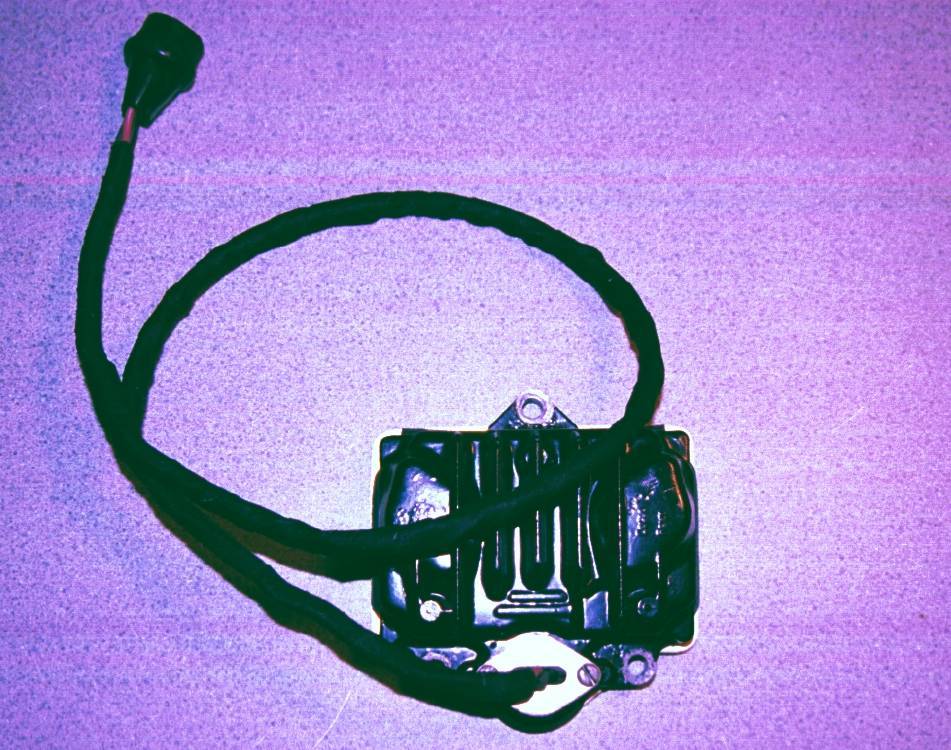
OTC TI Amplifier PN 1115343.
(Note pigtail-style connector cable.)
(click on the image to expand it)
 |
The circuit board inside the amplifiers on both PN 1115005
and PN 1115343 are the same. The only changes are the
housing cover and the electrical connection. Many 343
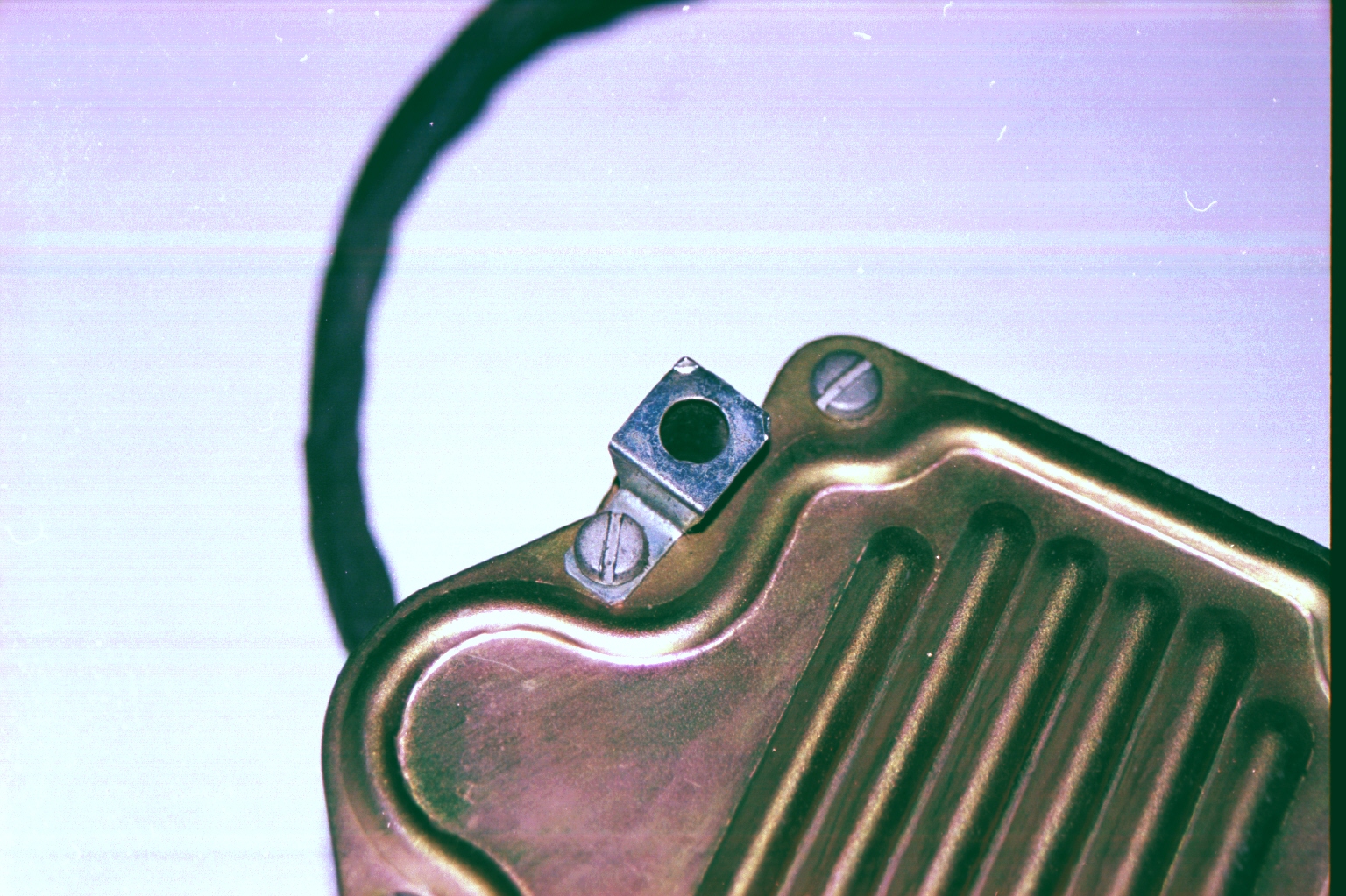
amplifiers came with a special grounding clip that was
attached with one of the back cover screws. The new 343
amplifier requires a different wiring harness (more about
that later). The amplifiers have the appropriate identifying
part number stamped on their housings. Many amplifiers had a
date code stamped in ink on the back cover.
Ground Clip for 1115343 Amplifier.
(click on the image to expand it)
 |
One of the interesting things about the new 343 amplifier is
that it was not listed in the Heavy Duty Parts lists until
some time after May 1969. OTC TI systems apparently
continued to come with the 005 amplifier despite the new 343
version being available. It is also interesting to note that
all 1969 ZL1's that were built between late
December 1968 and May 1969 came exclusively with 343
amplifiers. OTC systems had to wait for this upgrade!
When the new 343 amplifier came out, a replacement amplifier
assembly kit became available for use on older PN 1115005
amplifier systems. This kit (PN 3955511) included the new
343 amplifier and a special adapter harness connector to use
with the old 1115005-style harness. This kit was listed in
the Heavy Duty Parts publications some time after May 1969.
Amplifier Mounting Plates
Chevrolet specified that the amplifier be mounted on a
special plate that was attached to the hood latch support
bracket. This would place the amplifier directly behind the
grille to allow cool air to flow over it. The first
amplifier mounting plate was PN 3916730, and was used on the
OTC systems during 1967, 1968, and early 1969. (The May 1,
1969 Chevrolet Heavy Duty Parts list shows another number PN
3916739 for the 302, but this appears to be a typographical
error.) The same publication shows another mounting plate,
PN 3954206, for 302, 396 and 427 applications, perhaps
intended to completely replace the earlier plate. The 1969
ZL1 used plate PN 3954206 exclusively. After 1969 the plate
was dropped and, on later applications (1970 and up), the
amplifier was mounted directly to the lower portion of the
hood latch support brace.
It is not known how these part numbers may have differed.
This seems to be an area of confusion and would be a good
topic for further research.
Amplifier Mounting Position, Top View.
(click on the image to expand it)
 |
Amplifier Mounting Position, Closer View.
(Closer view of mounting.)
(click on the image to expand it)
 |
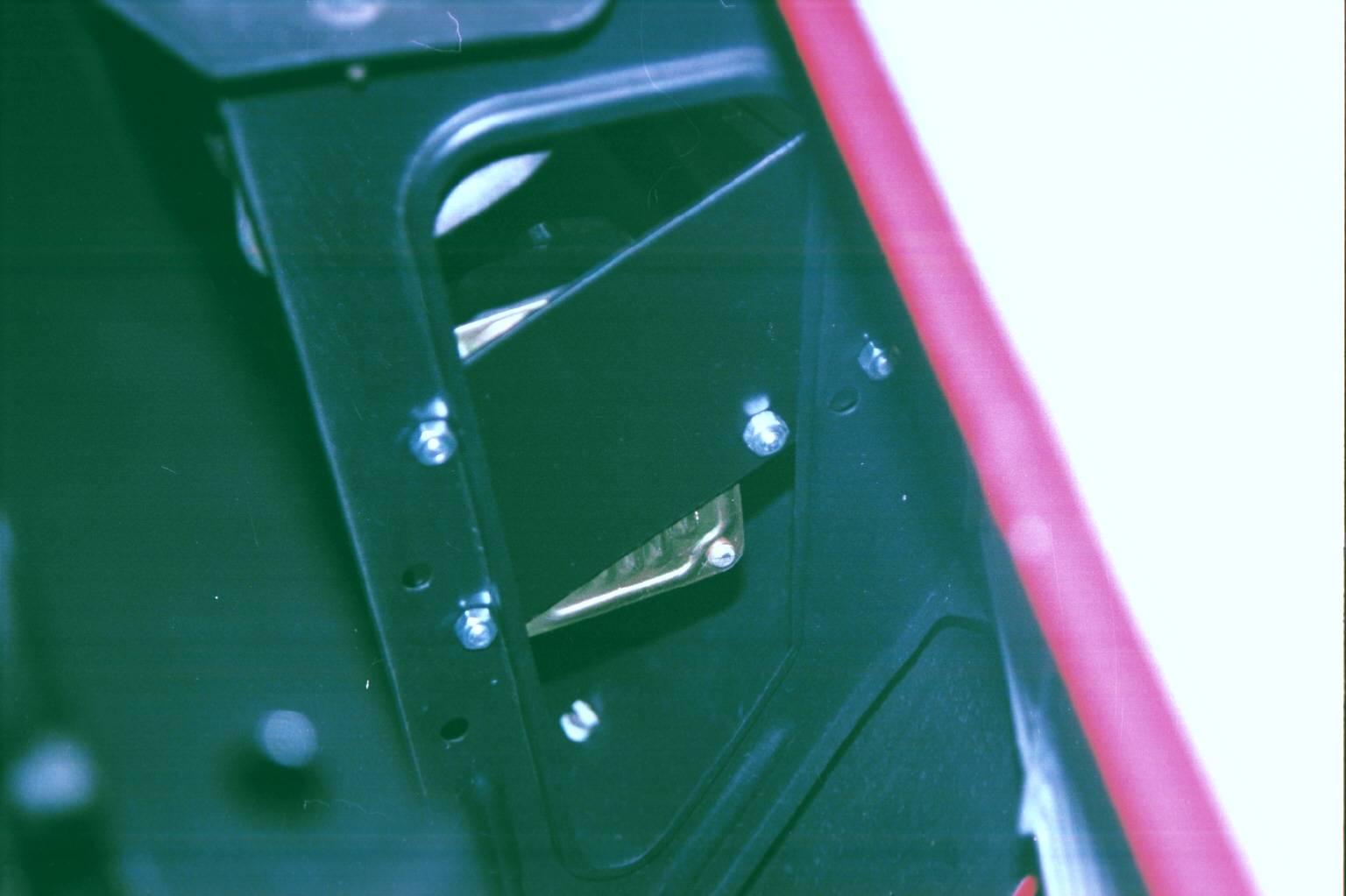
Amplifier Mounting Position, Grille-Side View.
(View as seen from exterior grille side.)
(click on the image to expand it)
 |
Transistor Ignition Coils
TI systems use a special ignition coil. These coils have
lower impedance than the standard ignition coils and are
capable of flowing much higher current. This allows them to
make a hotter spark at high RPM ranges when the spark plug
voltage requirement is higher. A standard coil is not able
to generate sufficient secondary voltage to work properly in
this application. Though there were several TI coil numbers,
only two pertain to use on the Camaro. PN 1115207 ("207")
was the coil used for all OTC systems and as the service
replacement. PN 1115210 ("210") was the exclusive coil that
came from the factory on the 1969 ZL1 Camaro and could not
be purchased at the dealer as a service item.
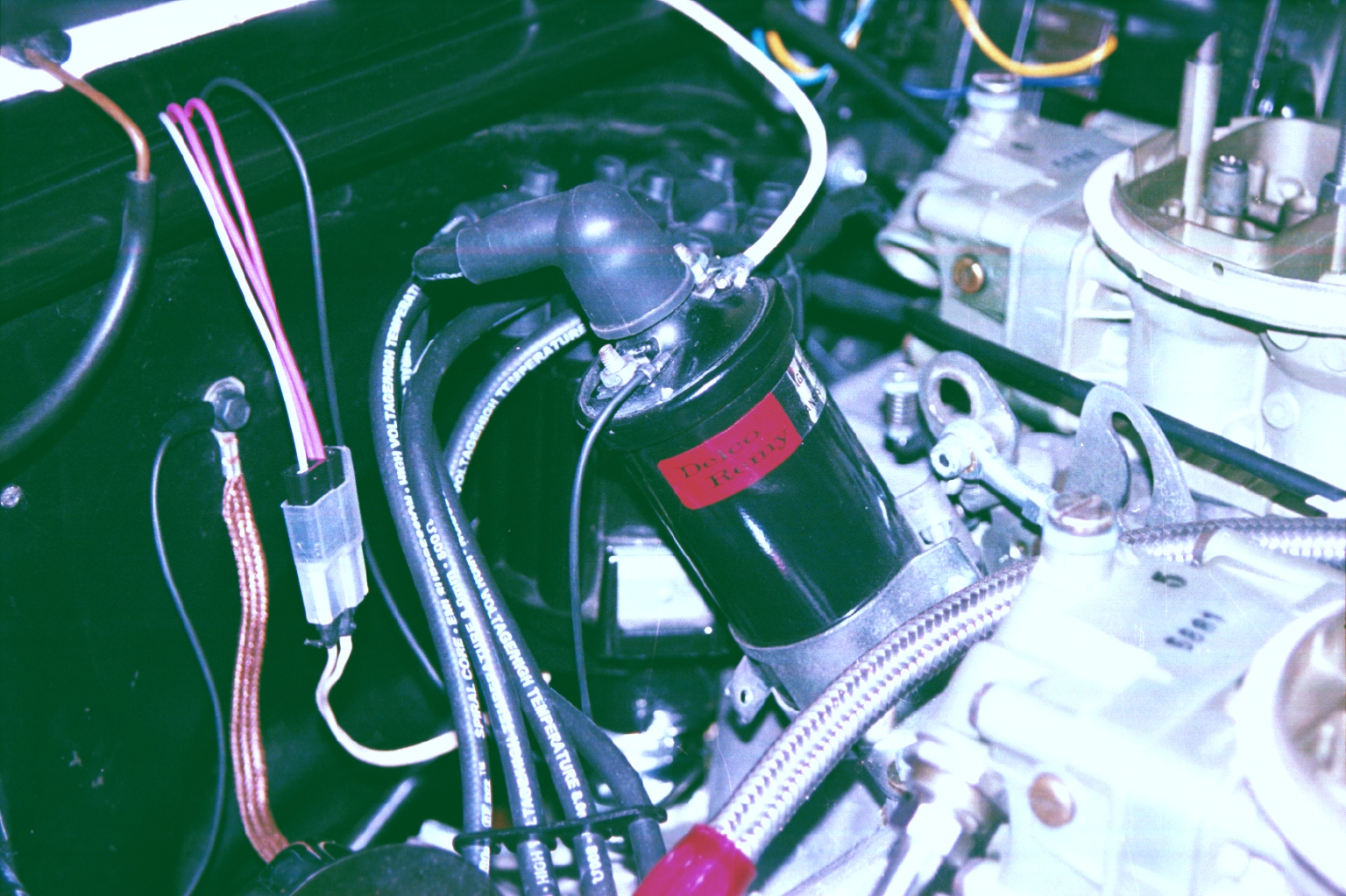
TI Coil Mounting.
(Shown here on a 1968 Cross-Ram intake car - note the
special decal and harness connector.)
(click on the image to expand it)
 |
The TI coil differs in that the negative terminal is
grounded directly to either (depending on the year and type
of wiring harness) the firewall or the engine. In contrast,
the standard ignition coil connects the negative terminal to
the distributor wire and the electrical path passes through
the points before going to ground. The TI coil receives
2.5-4.5 volts with the ignition switch turned on while the
engine is off; in contrast, the standard coil operates at
about 9 volts. Both coils receive 12 volts from the starter
solenoid during starting.
Note that because the TI system creates the spark on the
positive side of the coil (opposite from a points system,
which generates the spark on the negative side), on an
engine analyzer the graph or curve generated by TI has the
opposite sign from that produced on a points ignition.
As mentioned, these Transistor Ignition coils have a lower
impedance across the primary terminals. Standard coils
measure 1.24- 1.46 Ohms. The TI coil measures 0.41-0.51 Ohms
and most can be identified by a three-digit raised number,
either 207 or 210, on the side of the case. These coils came
with a special decal on the side indicating they were for
the Transistor Ignition system. The first 207 coil was later
replaced by a second version that had the full part number
boldly stenciled in white on the side case (without any
embossed numbers). A still later third version of the 207
coil made in Japan had a finely stenciled white part number
and a different style coil wire tower, again without
embossed numbers.
Wiring Harness
The wiring harness is where things get very complicated.
Confusion results primarily because of the amplifier change.
If you remember that each amplifier had a different wiring
harness system, it will be much easier to follow.
Definitions of main and extension harness complicated
matters as well. Keep these points in mind while reading
through the next four subsections. Most of these harnesses
are available in reproduction from either M&H Electrical
Fabricators or Factory Fit (see the contact information at
the end of the article).
Some of the very first Pontiac TI systems used two separate
external resistors in the system. You may read about them in
some early Transistor Ignition literature. Thankfully, these
resistances were built into all Camaro Transistor Ignition
wiring harnesses and you need not concern yourself about
them.
1967-69 OTC Wiring Harness-a borrowed system
The first TI harness used on the Camaro for the 1967, 1968
and at least some of 1969 models was the PN 2988218 Ignition
Pulse Amplifier Harness Assembly and the PN 6287841 Ignition
Pulse Amplifier Extension Harness Assembly. These two
harnesses comprise the "main harness" (as it would come to
be known in later years). The 218 harness went from the
amplifier in the grille to the firewall, via the lower left
fender. The 841 harness is sometimes called the starter
extension harness as it goes down to the starter solenoid
(as well as to the distributor and coil). Both of these
harnesses have a separate ground wire included into them.
The 218 harness has a wire that grounds the amplifier to the
radiator support. The 841 has a wire that grounds the coil
negative terminal to the firewall.
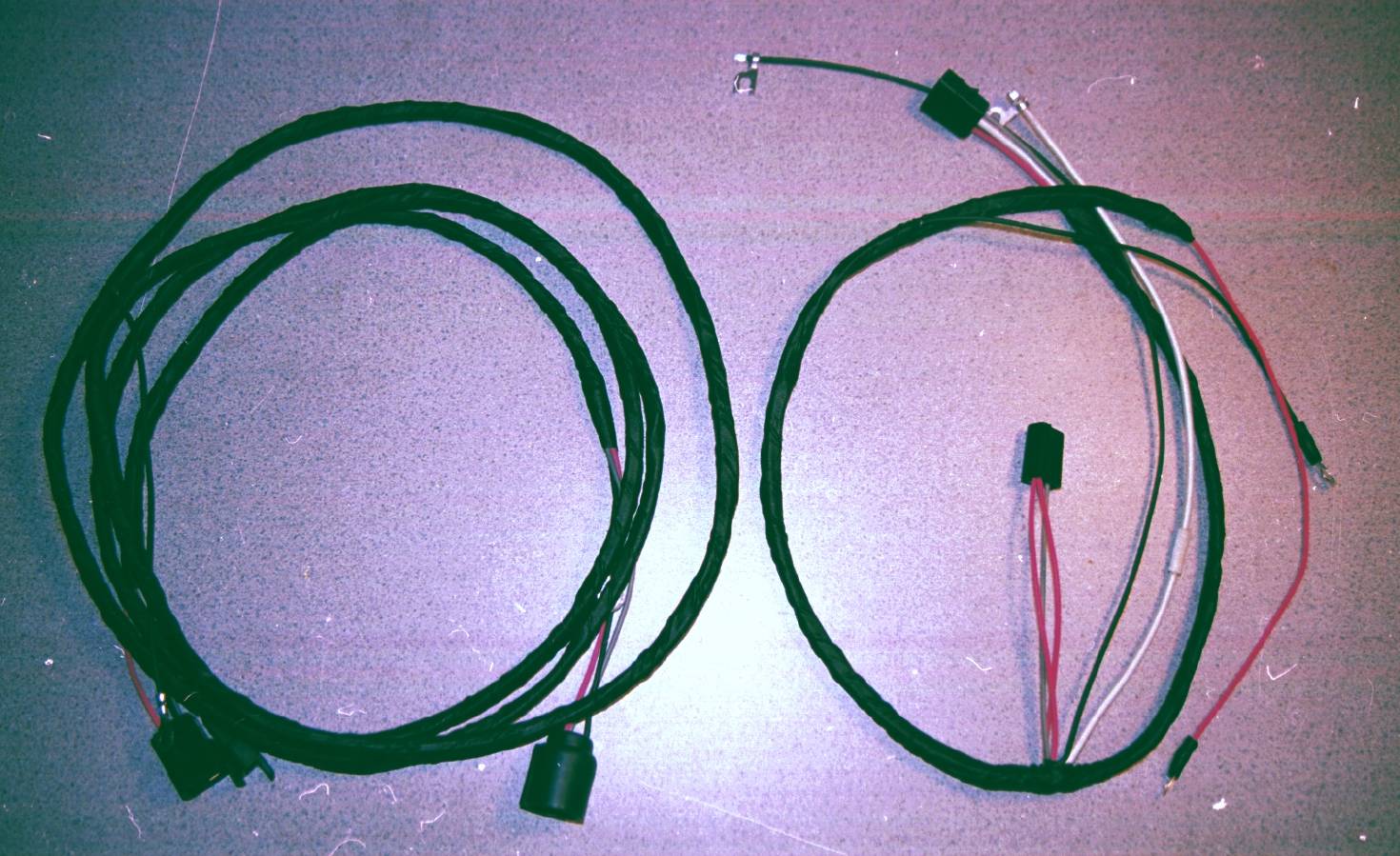
Two Early OTC TI Harnesses.
(Early OTC harnesses: PN 2988218 on left, PN 6287841 on right.)
(click on the image to expand it)
 |
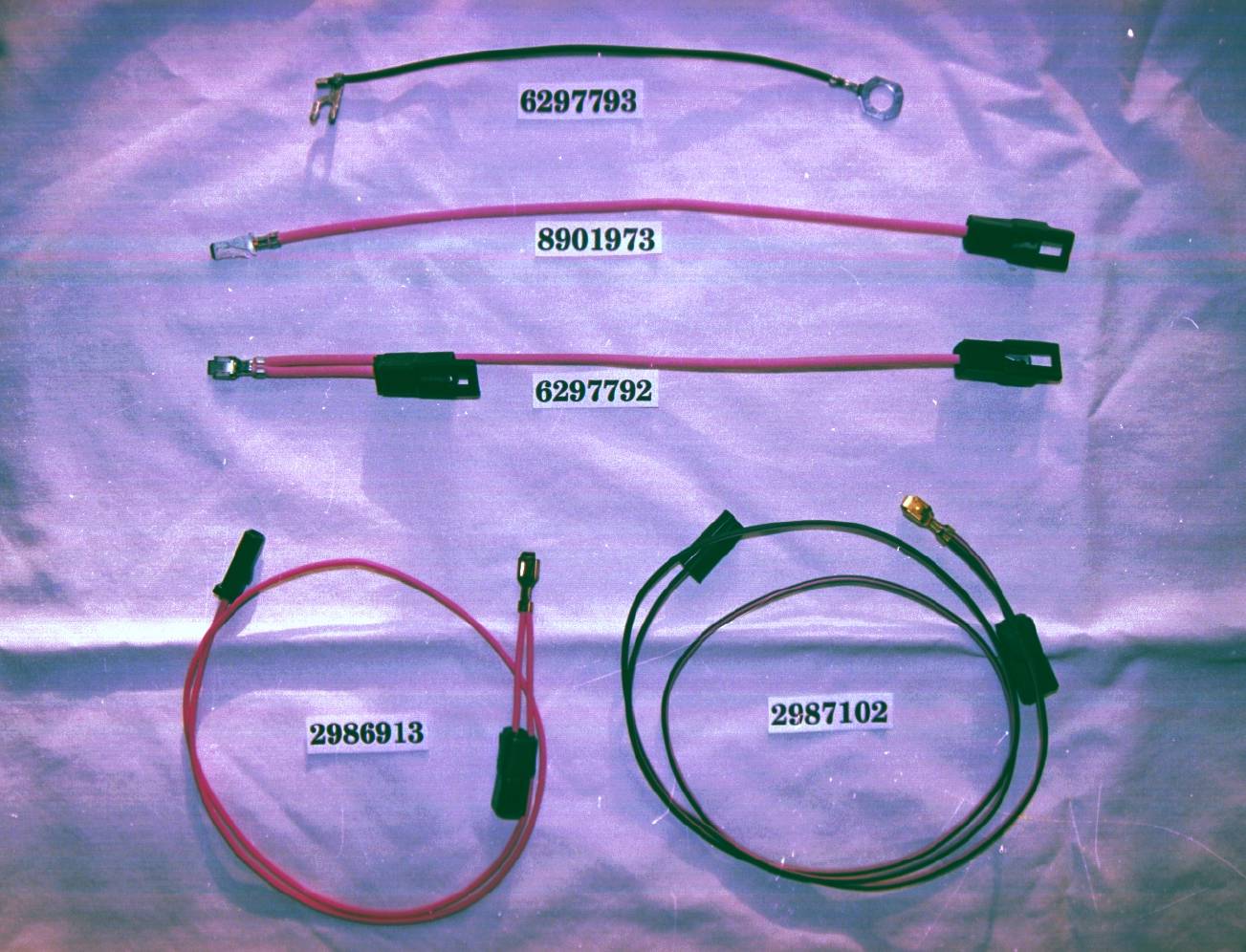
The third wire harness required on the 1967-68 setup is the
PN 2987102 Ignition Switch to Ignition Pulse Amplifier Wire
Assembly (WOW!). The 1969 OTC system may have used this
harness as well. (Note: PNs 8901973 or 6297792 cannot be
used in this application.) This short harness went from the
218 harness through the firewall to the ignition switch
directly. The hole to be drilled in the firewall for this
wire was specified to be 11/16-inch.
Other TI Wire Sets.
| From top to bottom: |
| Ground Wire |
| PN 6297793 |
| Starter Switch Extension Wires |
| PN 8901973 (post 1969 OTC) |
| PN 6297792 (ZL1) |
| PN 2986913 (1968-69 OTC) |
| PN 2987102 (1967-68 OTC)) |
(click on the image to expand it)
 |
Detailed instructions were provided on Chevrolet instruction
sheet PN 3916731, released November 4, 1966. These
instruction sheets were a part of the PN 3921048
Transistorized Ignition Unit.
May 1, 1969 Changes to OTC Harnesses
In the Chevrolet Heavy Duty Parts list dated 5/1/69, the OTC
Ignition Impulse Amplifier Harness Assembly was changed to
PN 6300109, which was listed for 302, 396 and 427
applications. Another Ignition Impulse Amplifier Extension
Harness Assembly, PN 2988219, was added for 396 and 427
applications. The PN 6287841 starter extension harness
listed above remained available and was now listed
exclusively for the 302. A new Ignition Switch to Ignition
Pulse Amplifier Wire Assembly, PN 2986913 was listed for the
396 and 427 applications. It is uncertain what ignition
switch wire was specified for the 1969 302. It is likely
that PN 2986913 was specified for all Camaro applications,
replacing the earlier PN 2987102.
These harness changes continued to use the PN 1115005
amplifier unit, despite that the new PN 1115343 amplifier
had been released (more that one year earlier!) on the
Corvette. TIU 3921048 continued to be available.
The 1969 ZL1 Wiring Harness-getting simpler and better
The 1969 ZL1 Camaros were built between late-December 1968
and May of 1969.
These cars used an Ignition Pulse Amplifier Harness Assembly
PN 6297791 (later revised in April 1969 to PN 6297688.) This
harness was made to work with the new improved PN 1115343
pigtail amplifier. This single main harness replaced the
two-piece main harnesses that were on the previous OTC
systems. This new harness utilized the existing yellow wire
from the starter solenoid, making it unnecessary to use the
previous starter extension harness.
A special Ignition Pulse Amplifier Feed Wire Assembly, PN
6297792, connected to the ignition switch
connector at the base of the steering column and provided
the ignition switch power. The factory instruction manual
specified a 3/4-inch hole be drilled through the firewall
for this wire. The ground wire for the amplifier was
dropped. Apparently the factory was satisfied that the
housing had an adequate ground by its mounting method. The
coil had a separate short ground wire, PN 6297793,
from the negative terminal to the coil bracket mounting
bolt. Details of this installation can be found in the 1969
Assembly Manual under COPO 9560.
Post May 1969 OTC Wiring Harness Systems-the simplest to set
up
It is unclear exactly when, but sometime after midyear 1969,
the OTC TI systems adopted the simplicity and improvements
of the ZL1 TI setup. The change to the new main harness was
made with the PN 6297688 Ignition Pulse Amplifier Harness
Assembly. The PN 6297793 short coil ground wire was also
used.
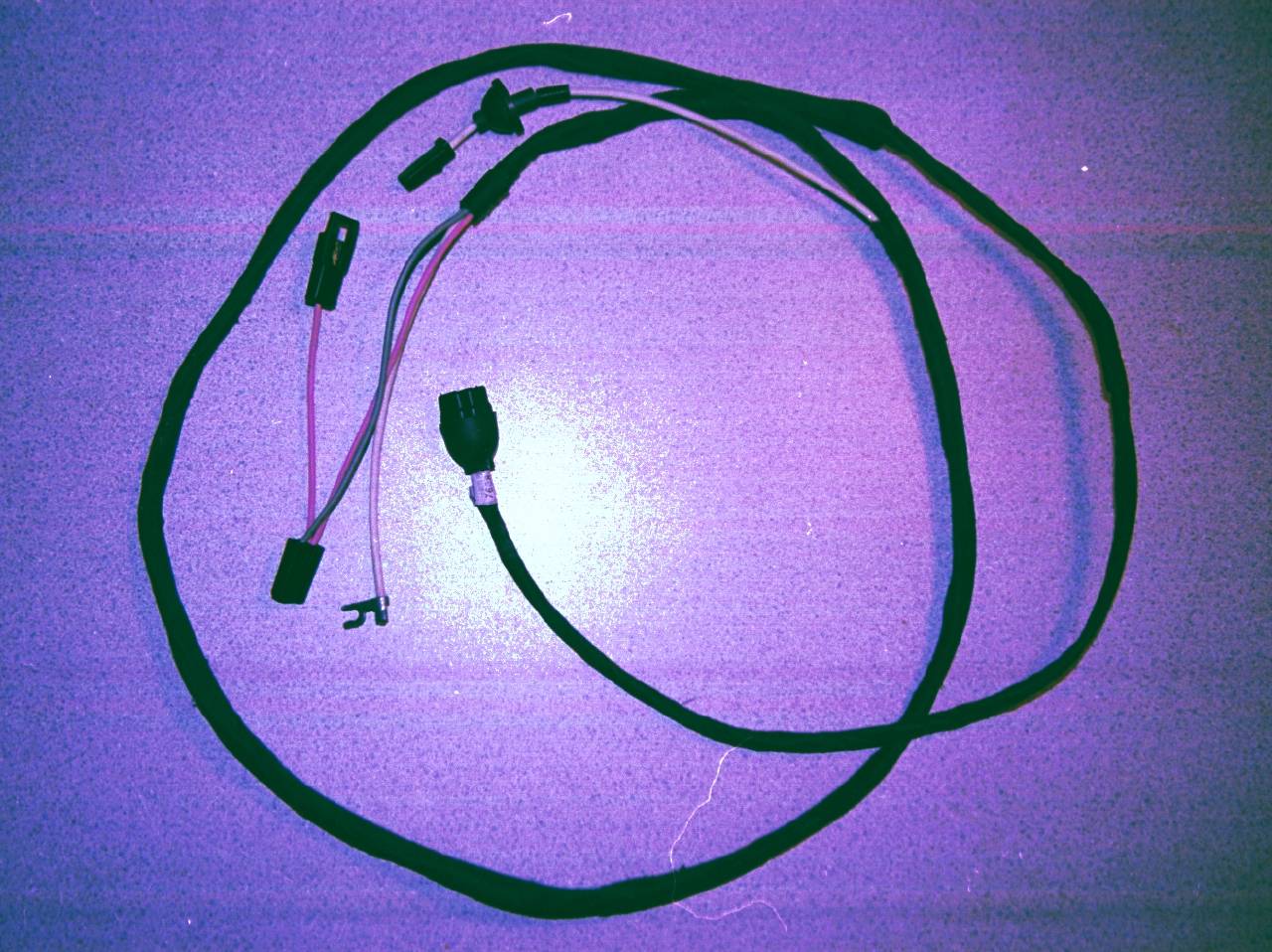
6297688 TI Main Harness.
(click on the image to expand it)
 |
A new Pulse Amplifier Ignition Feed Wire Assembly, PN
8901973, was released to connect to the fuse box wiring
bulkhead connector in the engine compartment, after the coil
positive wire was removed from it. This new generic wire
allowed simple connection for all applications. It was no
longer specified to drill a hole and connect to the ignition
switch inside the car. The new 1115343 amplifier was used
with this setup. The new amplifier will not connect to the
previous 1115005-style harnesses. The instructions for
setting up this version were in the Chevrolet Special
Equipment manual (aka Green Sheets), which are currently
being reproduced. Instructions can also be found on
Chevrolet instruction sheets PN 3965743 which were dated
November 16, 1970. This was the last harness available for
use on the Camaro OTC systems. Note that this version
continued to be available for the 1970-72 Camaros.
Miscellaneous Parts
The miscellaneous pieces of the system (retainers, grommet,
wiring connector, and instruction sheets) warrant some
discussion.
The 1967-69 OTC system specified special ties to hold the
wiring harness in place. These appear to be the same as the
windshield washer hose loop through ties. Later versions,
including the ZL1, specified the harness be taped in several
locations.
The grommet was for either an 11/16-inch (early OTC) or
3/4-inch (1969 ZL1) hole drilled in the firewall to protect
the ignition switch feed wire.
The electrical connector was used to (early) hook up the
ignition feed wire to the ignition switch connector
OR (later) to hook up the existing yellow starter
solenoid wire to the main harness.
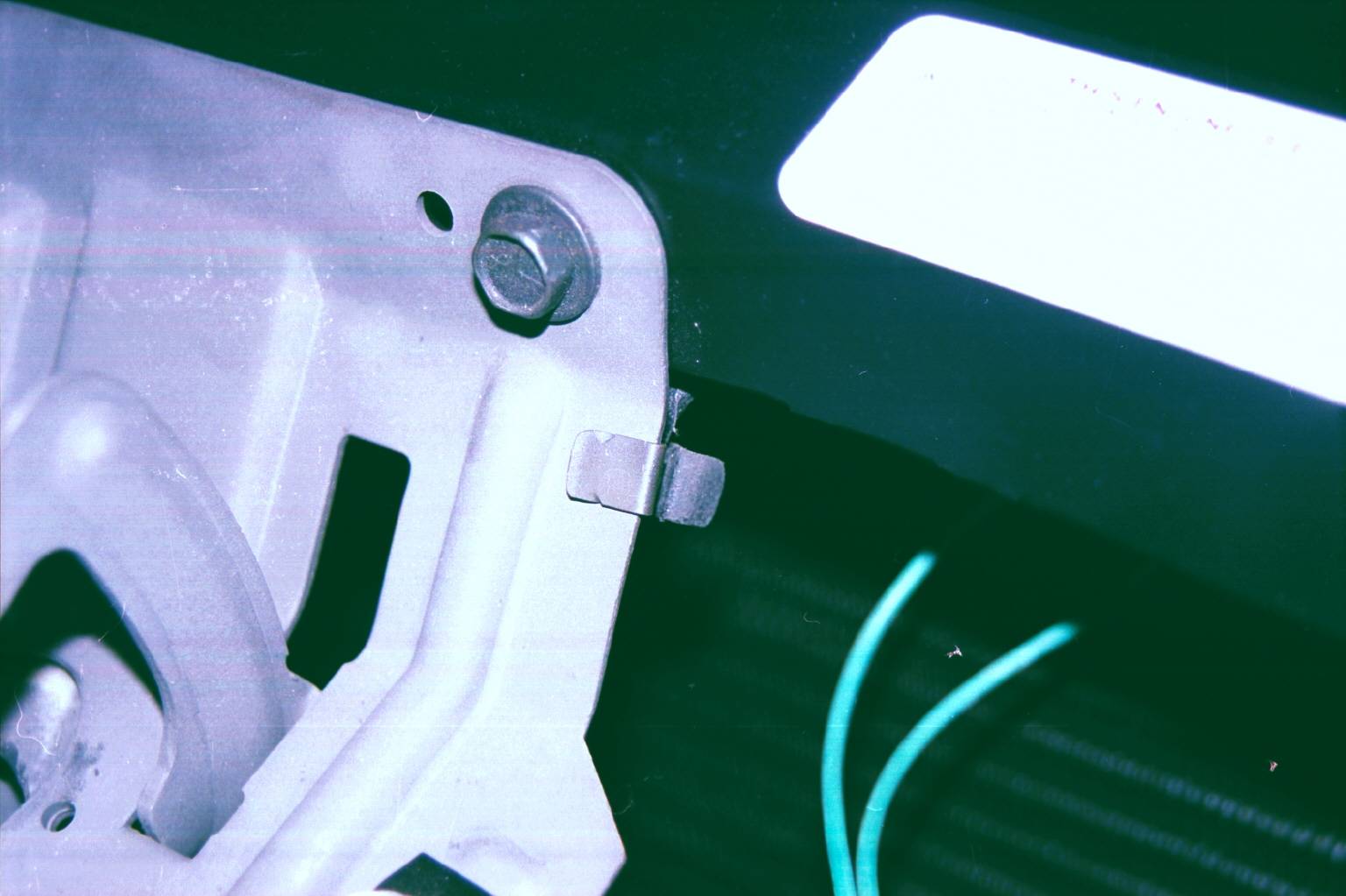
A special wiring harness clip, PN 3827371, was made to hold
the amplifier harness to the hood latch plate. This is
similar, but not identical to, the trunk light wire harness
clip, as can be seen in the comparison below between between
the 3827371 clip and the standard trunk light clip.
3827371 Wire Clip In Installed Position.
(click on the image to expand it)
 |
Clip Comparison.
(click on the image to expand it)
 |
Following the appropriate instruction sheets during
installation is highly recommended! Known instruction sheets
in chronological order are: PN 3916731 dated 11-4-66, COPO
9560 ZL1 1969 Assembly Manual Instructions dated 12-16-68,
PN 3965743 dated 11-16-70, and Chevrolet Special Equipment
Green Sheets revised 3-9-72. It is possible other
instructions sheets exist; if you have any not listed above,
the author would like to hear from you.
Transistorized Ignition Unit Kit
The Transitorized Ignition Unit (TIU) kit saved the
installer from numerous headaches, and included everything
except the distributor. The content of these TIU's changed
over the years because of the many revisions previously
described, but it contained all of the correctly matched
parts. It included the amplifier, ignition coil, wiring
harnesses, mounting plate, grommet, electrical connectors,
wiring straps, and instruction sheets.
TIU PN 3921048 was the first such TIU for the Camaro, and
the instruction sheets were Camaro specific. It was used
from its introduction March 7, 1967 through at least 1969.
Again, the parts in the kit varied by the date at which it
was purchased. The later Chevrolet Green Sheets list the
Transistorized Ignition Unit PN 3997782 which included the
parts needed to setup with the more weather resistant 343
amplifier. This was a more generic kit for any Chevy racing
application.
The Tachometer Issue
Camaro TI distributors, like most others, came with a
mechanical tachometer drive mechanism. It was speculated
that the racer would use a mechanical tachometer. A
mechanical tachometer can be setup but you may find it
difficult to run the cable. The author has set one up
successfully in a 1968 Camaro without butchering his
vehicle, but it is challenging. You will find that your
factory electronic tachometer will not read accurately if
you try to drive it from the coil terminals (either + or -
terminals) Apparently Stewart Warner used to make an adapter
to drive their tachometers on a TI system. It is unknown if
the adapter will drive a factory tach.
A special service bulletin from Delco-Remy for connecting a
test tachometer to the system was released April 15, 1965.
(Bulletin 1.2D-19) To use a tune-up tach, first locate the
two-wire distributor connector. Find the side that the solid
white wire is on. Connect your tachometer positive (+) lead
to this point (easiest to attach on the other side of the
distributors mating connector). The tachometer negative (-)
lead should then be connected to the coil positive (+)
terminal. (Yes - you read this right!) The author has
successfully used a tune-up tach this way, but it seems to
only work on tachs that have a separate power wire that
attaches to the battery positive (+) terminal. Aftermarket
performance tachometers (ones that don't have a separate
12-volt power wire) seem to not function when attached this
way.
At least six of the sixty-nine ZL1's came with a factory
tachometer. It is believed that they utilized standard
production tachometers, but it is unclear how they addressed
these issues.
However, we may be in luck as Mr. Dave Fiedler of T.I.
Specialty is working on an electrical adapter to drive the
factory tachometer. His company services, repairs and
supplies parts for TI systems. He is extremely knowledgeable
about TI systems and the author highly recommends him.
Components Summary Table
Summarized in the following table are the components
discussed in this article. This will help to clarify these
TI systems and their components. The next time you are at a
car show, you may want to look carefully to see if you can
identify one of these obscure systems. They are quite a
conversation piece and an asset to the value of any car. Be
prepared to look at a lot of cars until you spy one though!
OTC OTC 1969 ZL1 OTC
1967-May 1969 May 1969 Factory Post May 69(1)
Distributor 1111267 (302) 1111267 (302) 1111927 1111267 (302)
1111263 (race) 1111263 (race) 1111263 (race)
Amplifier 1115005 1115005 1115343 1115343
Mounting Plate 3916730 3916739?(2) 3954206 none
3954206(all)
Coil 1115207 1115207 1115210 1115207
Main Harness 2988218 6300109 6297791 6297688
and and either (thru 4/69)
6287841 6287841 (302) 6297688
or (post 4/69)
2988219 (BBC)
Ign. switch wire 2987102 (67-68) TBD (69 302)(3) 6297792 8901973
(and 69?)(3) 2986913 (BBC)
Ground wire in harnesses in harnesses 6297793 6297793
TI Unit 3921048 3921048 none 3997782
Instruction sheets 3916731 TBD COPO 9560 3965743
(1969 AIM) & Green Shts
Footnotes:
(1) This change may have been in 1970. It was after the May 1969 Heavy Duty Parts list publication.
(2) This part number may be a typographical error in the parts book - most likely was PN 3916730.
(3) Part number used is not clear for these applications. See text for recommendations.
Appendix - A Brief Overview of the Function of the System
A conventional points ignition uses a point set on the
8-lobe distributor cam to make and break electrical contact
to the coil. In contrast, the transistor ignition uses a
magnetic pickup and a set of transistors to accomplish the
function of the points in a conventional system. For
advance, TI systems use similar (mechanical or vacuum)
mechanisms to the conventional system.
In the TI distributor is a finely coiled wire bundle that
surrounds the mainshaft. The 2 ends of this coil eventually
come out of the distributor and become the 2-wire
distributor connector. This coil is attached to a permanent
magnet and then to an 8-pointed iron ring called the
stationary pole piece. The 8 metal points face toward the
mainshaft. This entire assembly is called the magnetic
pickup.
When another corresponding 8-pointed disc (the Rotating Pole
Piece) is placed on the mainshaft and then rotated, you have
the ability to generate an AC current in the 2 distributor
wires. This AC signal can be measured with an AC voltmeter
(or on an oscilloscope, if you have one). An AC voltage of
about 1 Volt at around 225 RPM indicates a properly
functioning Magnetic Pulse signal.
The trick now is to use this magnetic pulse to generate the
spark event by the coil. This signal is amplified by the
transistor board assembly in the amplifier box. The
amplifier board has a number of transistors, resistors,
diodes and capacitors that serve to send electrical current
to the ignition coil and then, at the proper moment, cut it
off, just like the points do in a conventional system. A
triggering transistor receives the magnetic pulse signal and
causes a sequence of events that result in disrupting the
coil current (shuts off electrical current to the coil) and
thus generates a spark. Notice that the TI system creates
the spark on the positive wire side of the coil, unlike the
conventional system, which does it on the negative side of
the coil.
An important thing to remember is that the high secondary
voltage created by the TI coil should not be allowed to jump
into the amplifier wiring. If you have some bad spark plug
wires, or are testing for a spark at the end of a plug wire,
be certain to have a good close ground (use an extra
spark plug at the end of the wire) The reason for this is
the TI coil generates a much hotter spark. If the spark
cannot find its normal ground, it will find another path; if
necessary it will jump to the coil terminals and through the
wiring harness to the amplifier. This usually arc welds some
electrical components and renders the amplifier
non-functional. There are some protective capacitors in the
amplifier but they cannot protect against all electrically
induced damage! Be certain to keep the secondary system
(cap, rotor, wires and plugs) in top notch condition
to avoid killing your amplifier.
A much more in depth discussion of system theory, function
and servicing can be found in the Delco-Remy Service
Bulletin 1D-155 dated July 1, 1965 and in the original SAE
paper Delcotronic Transistor-Controlled Magnetic Pulse-Type
Ignition System presented January 14-18, 1963. They both
have a lot of useful information. It is highly recommended
to read this information if you are running a TI system.
Resources
M&H Electrical Fabricators, Inc., (562) 926-9552, www.wiringharness.com
Factory Fit, (856) 933-0801, www.factoryfit.com
Dave Fiedler of T.I. Specialty, (765) 962-4265, www.tispecialty.com